11-Day Bhutan Culture and Nature Tour with Tiger's Nest Hike


About This Tour
Explore Bhutan's art, culture, and natural beauty on an 11-day journey through Thimphu, Punakha, Bumthang, Lhuentse, Gangtey, and Paro. Visit important cultural...
Duration: 11 Days · Tour type: Private · Activity level: Moderate · Accommodation: Included · Standard · Transport: Included · Wheelchair access: Not applicable · Cities: Thimphu, Wangdue, Paro, Punakha, Phobjikha, Bumthnag, Trongsa, Gangtey, Lhuntse · Languages: English
Know before you go: Why is weaving so special here? Weaving is an ancient art in Bhutan. Taking root in a rural and rustic setting, a uniquely rich weaving tradition has evolved and flowered over time. With skills handed down from generation to generation, mother to daughter, and from family to family, weaving in Bhutan is today an art form representing the country's very heart and soul.; About Shangzo: It is a widely practised ancient art of woodturning passed down for generations. Bhutan's abundant and wide range of woods like Tashing (Juglans Regia), Hashing (Taxus Baccata), Baashing (Picea Spinulosa), Tsenden Shing (Cupressus corneyana), Sermaling Shing (Acer Camphellii), and Etometo (Rhododendron arboretum) have enabled the Bhutanese Shagzopa to create a variety of exquisite functional and decorative products like turned wooden bowls, cups, plates, and containers of various shapes, sizes, and colours unique to Bhutan. Most of these wooden articles are made for daily use, apart from being good showpieces and souvenirs. Specially turned wooden articles are saved as family heirlooms. The prices of these articles are measured in terms of the quality of wood used, the quality of lacquer finish, uniqueness, size, and colours.
About Wangdue

Wangdue
The nerve center of Vajrayana Buddhism and one of the most mythical locations in the Himalaya, Wangdue and its great dzong rarely fail to impress. Get a local guide to show you around.
What's Included
- Private guided tour
- Qualified and licensed English-speaking Bhutanese tour guide
- Guaranteed Bhutan visa
- Airport transfers
- Daily 3 meals (B/L/D) at designated restaurants or hotels
- Accommodation at a 3-star hotel (our partner hotels)
- Imported SUV tour vehicle and experienced driver
- Horse riding
- Entry fees and road permits
- Mineral bottled water
- Full service and assistance before, during, and after your Bhutan trip
- A sustainable tourism royalty of $65 that goes towards free education, healthcare, poverty alleviation, and infrastructure building
Not Included
- Hotel stay outside Bhutan
- Meals at 5-star restaurants
- Tips for the Bhutanese guide and driver
- Alcoholic drinks
- Expenditure of a personal nature
- Flights into Bhutan with Druk Air or Bhutan Airlines
Itinerary
-
1Day 01
Explore the Art and Culture of Thimphu
Meet your guide at Paro airport and head to Thimphu, the modern capital town of Bhutan, at 7,600 feet. Meet your guide at Paro airport and head to Thimphu, the modern capital town of Bhutan, at 7,600 feet. Have lunch and visit the National Library of Bhutan to see a vast collection of ancient Buddhist manuscripts and the world's largest book. Have lunch and visit the National Library of Bhutan to see a vast collection of ancient Buddhist manuscripts and the world's largest book. Explore the magnificent art at the Arts and Crafts School, also known as 'Zorig Chusum', a traditional school of 13 arts and crafts. Explore the magnificent art at the Arts and Crafts School, also known as 'Zorig Chusum', a traditional school of 13 arts and crafts. Stroll around the town in the evening and see Bhutanese textiles displayed in almost every shop. Stroll around the town in the evening and see Bhutanese textiles displayed in almost every shop. Stay for the night in Thimphu.
-
2Day 02
Visit the Fertile Valley of Punakha
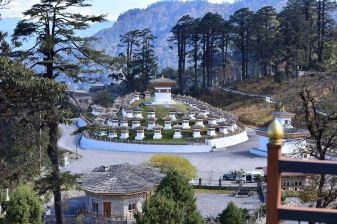
Have breakfast and head for Dochula Pass (10,000 ft.) to witness one of Bhutan's most enchanting views. On a clear day, you can see the craggy peaks of Bhutan's northern Himalayan border. Have breakfast and head for Dochula Pass (10,000 ft.) to witness one of Bhutan's most enchanting views. On a clear day, you can see the craggy peaks of Bhutan's northern Himalayan border. Continue to Punakha, a fertile valley drained by the Phochu and Mochu rivers and blessed with a temperate climate. Before Thimphu was made the capital of Bhutan, Punakha held the title of the winter capital because of its milder weather. Today, it is the winter seat of the Je-Khenpo (the Chief Abbot) and the Central Monk Body. Continue to Punakha, a fertile valley drained by the Phochu and Mochu rivers and blessed with a temperate climate. Before Thimphu was made the capital of Bhutan, Punakha held the title of the winter capital because of its milder weather. Today, it is the winter seat of the Je-Khenpo (the Chief Abbot) and the Central Monk Body. Visit Punakha Dzong (Palace of Great Happiness), built at the junction of the Phochu and Mochu rivers in 1637 by Shabdrung Ngawang Namgyal. In the past, this majestic dzong served as Bhutan's religious and administrative center. It measures 600 by 240 feet and has a six-story, gold-domed tower. Inside are courtyards and religious statuary, hinting at the depth of history and spiritual tradition embodied here. Visit Punakha Dzong (Palace of Great Happiness), built at the junction of the Phochu and Mochu rivers in 1637 by Shabdrung Ngawang Namgyal. In the past, this majestic dzong served as Bhutan's religious and administrative center. It measures 600 by 240 feet and has a six-story, gold-domed tower. Inside are courtyards and religious statuary, hinting at the depth of history and spiritual tradition embodied here. Spend the night in Punakha.
-
3Day 03
Learn Weaving Traditions in Chumey Valley
Travel to Bumthang Valley, taking in terraced farmlands and deep river valleys, and stop at Trongsa Dzong, the ancestral home of Bhutan's monarch. Travel to Bumthang Valley, taking in terraced farmlands and deep river valleys, and stop at Trongsa Dzong, the ancestral home of Bhutan's monarch. Visit the valleys of Chumey, the heart of the famous Bumthang Yathra weaving region, to see the Center of Yathra Weaving. Yathra is the name for the locally produced hand-woven woollen cloth. Its distinctive patterns and bright, earthy colours make it one of the most sought-after fabrics throughout Bhutan. See the vegetable dye techniques used on wool. Visit the valleys of Chumey, the heart of the famous Bumthang Yathra weaving region, to see the Center of Yathra Weaving. Yathra is the name for the locally produced hand-woven woollen cloth. Its distinctive patterns and bright, earthy colours make it one of the most sought-after fabrics throughout Bhutan. See the vegetable dye techniques used on wool. Continue driving to Jakar, about 20 km from Chumey Valley. Continue driving to Jakar, about 20 km from Chumey Valley. Stay for the night in Bumthang.
-
4Day 04
Engage in Cultural Exchanges at Khoma Village
Start early and head to Ura Valley, enjoying the scenery of snow-capped mountains, flowers, grazing yaks, and dense forest. Ura Village has a medieval look, with compact houses lining cobblestone streets, and is known for women's typical sheepskin shawls. Start early and head to Ura Valley, enjoying the scenery of snow-capped mountains, flowers, grazing yaks, and dense forest. Ura Village has a medieval look, with compact houses lining cobblestone streets, and is known for women's typical sheepskin shawls. Proceed to Thrumshing La Pass (3,750 m/12,300 ft.), which officially divides Central Bhutan from Eastern Bhutan, and see beautiful waterfalls along the way. Proceed to Thrumshing La Pass (3,750 m/12,300 ft.), which officially divides Central Bhutan from Eastern Bhutan, and see beautiful waterfalls along the way. Cross the bridge over the Kurichu, passing cliffs and river valleys to reach Lhuentse, the original home of Bhutan's royal family in the remote and ancient region of Kurtoe. Cross the bridge over the Kurichu, passing cliffs and river valleys to reach Lhuentse, the original home of Bhutan's royal family in the remote and ancient region of Kurtoe. Stop at Lhuentse Dzong, built in the 1600s, and then continue to Khurbazam Village, a 10-15 minute drive from Khoma Village. Almost all 30 houses in the village have blackstrap looms for 'kishuthara' or brocaded dress. Four supplementary wefts are interworked around the warp elements so that they appear to ride the surface of the cloth like embroidery. Stop at Lhuentse Dzong, built in the 1600s, and then continue to Khurbazam Village, a 10-15 minute drive from Khoma Village. Almost all 30 houses in the village have blackstrap looms for 'kishuthara' or brocaded dress. Four supplementary wefts are interworked around the warp elements so that they appear to ride the surface of the cloth like embroidery. Spend your evening in cultural exchanges with locals and enjoy the locally brewed alcohol called 'Ara'. Spend your evening in cultural exchanges with locals and enjoy the locally brewed alcohol called 'Ara'. Go to your farmhouse in Khoma Village for the night.
-
5Day 05
Marvel at the Beauty of Lhuentse
Head to the originating place of the weaving art of Kishuthara to learn about and try the weaving process. This silk fabric features intricate hand-laced patterns and is the most expensive hand-woven Bhutanese textile in the country. It is also the primary source of income for the people here. Head to the originating place of the weaving art of Kishuthara to learn about and try the weaving process. This silk fabric features intricate hand-laced patterns and is the most expensive hand-woven Bhutanese textile in the country. It is also the primary source of income for the people here. Drive to Lhuentse, one of Bhutan's most rural and isolated districts, with a spectacular landscape of stark cliffs, gorges, beautiful conifer and pine forests, and remote villages surrounded by rice, millet, and cornfields. Drive to Lhuentse, one of Bhutan's most rural and isolated districts, with a spectacular landscape of stark cliffs, gorges, beautiful conifer and pine forests, and remote villages surrounded by rice, millet, and cornfields. Proceed to Menji Village and hike to see the statue of Padmasambhava (148 feet, with a 30-foot-high lion throne and a 17-foot-high lotus seat in the form of Guru Nangsi Zilnoen), built in Lhuntse to bring peace and harmony to the world as prophesied by Lord Buddha. It is the world's largest statue of Guru Padmasambhava. Proceed to Menji Village and hike to see the statue of Padmasambhava (148 feet, with a 30-foot-high lion throne and a 17-foot-high lotus seat in the form of Guru Nangsi Zilnoen), built in Lhuntse to bring peace and harmony to the world as prophesied by Lord Buddha. It is the world's largest statue of Guru Padmasambhava. Stroll freely in the village in the evening. Stroll freely in the village in the evening. Stay in the farmhouse for the night.
-
6Day 06
Discover the Art of Shangzo
Have breakfast and drive for 10 minutes to discover Shangzo, the traditional art of woodturning. See how exquisite functional and decorative products such as turned wooden bowls, cups, plates, and containers of various shapes, sizes, and colours are created, all unique to Bhutan. Have breakfast and drive for 10 minutes to discover Shangzo, the traditional art of woodturning. See how exquisite functional and decorative products such as turned wooden bowls, cups, plates, and containers of various shapes, sizes, and colours are created, all unique to Bhutan. Head to Minjeyi for the night's stay.
-
7Day 07
Drive Back to Bumthang
Have breakfast and set out on an 8-hour drive to Bumthang, with a picnic lunch along the way. Have breakfast and set out on an 8-hour drive to Bumthang, with a picnic lunch along the way. Have dinner and stay for the night in Bumthang.
-
8Day 08
Explore the Valley of Phobjikha
Have breakfast and drive east of the Wangdue mountains, where the beautiful Phobjikha Valley lies. This quiet, remote valley is home to black-necked cranes, which migrate from the arid plains of Tibet in the north to spend the winter months in a milder climate. The village of Phobjikha lies a few kilometres from the monastery on the valley floor. Have breakfast and drive east of the Wangdue mountains, where the beautiful Phobjikha Valley lies. This quiet, remote valley is home to black-necked cranes, which migrate from the arid plains of Tibet in the north to spend the winter months in a milder climate. The village of Phobjikha lies a few kilometres from the monastery on the valley floor. Visit the great monastery of Gangtey, along with Gangtey village, constructed in the 17th century. Visit the great monastery of Gangtey, along with Gangtey village, constructed in the 17th century. Have dinner and stay for the night in Gangtey.
-
9Day 09
Stroll Through the Lanes of Paro
Drive back to Paro and have lunch. Drive back to Paro and have lunch. Walk to Paro Dzong Fortress via the oldest wooden bridge and stroll around old Paro town to get a glimpse of the local handicraft stores. You may also get an opportunity to see a traditional match of archery. Walk to Paro Dzong Fortress via the oldest wooden bridge and stroll around old Paro town to get a glimpse of the local handicraft stores. You may also get an opportunity to see a traditional match of archery.
-
10Day 10
Hike to the Tiger's Nest Monastery
Hike the trail to the legendary Taktsang Monastery (Tiger's Nest) to witness Bhutan's most iconic site. You can also visit several other monasteries, including Zangthopelri and Ugyen Tshemo, which lie further up the hill and offer fewer tourists and more views. Hike the trail to the legendary Taktsang Monastery (Tiger's Nest) to witness Bhutan's most iconic site. You can also visit several other monasteries, including Zangthopelri and Ugyen Tshemo, which lie further up the hill and offer fewer tourists and more views. Head down to Paro Valley for a stop at Bhutan's oldest temple, Kyichu Lhakhang. Head down to Paro Valley for a stop at Bhutan's oldest temple, Kyichu Lhakhang. Return to Paro for a farewell dinner with your guide. Taste traditional Bhutanese dishes, including Ema Datshi (chilli and cheese), Jasha Maroo or Maru (spicy chicken), and Phaksha Paa (pork with red chillies). Return to Paro for a farewell dinner with your guide. Taste traditional Bhutanese dishes, including Ema Datshi (chilli and cheese), Jasha Maroo or Maru (spicy chicken), and Phaksha Paa (pork with red chillies).
-
11Day 11
Departure from Paro
Enjoy a hearty breakfast and head to the airport to catch your flight to your next destination. Enjoy a hearty breakfast and head to the airport to catch your flight to your next destination.
Meeting Point
Meeting point: Thimphu, Bhutan · Tour start: Thimphu, Bhutan — Tour ends at the same location as the start point.