5-Day Bhutan Cultural Tour from Paro with Tiger's Nest or Chelela Pass
About This Tour
Discover Bhutan's cultural and spiritual heart on a 5-day journey through Paro, Thimphu, Punakha, and Wangdue. Explore Thimphu's landmarks, including Buddha Poi...
Duration: 5 Days · Tour type: Private · Activity level: Easy · Accommodation: Included · Premium · Transport: Included · Wheelchair access: Yes · Cities: Thimphu, Wangdue, Paro, Punakha · Languages: English, Hindi
Know before you go: Smoking is allowed in Bhutan, but not in public areas.; Respect religious sites.; Our guide will brief you on arrival or on the first day.
About Thimphu

Thimphu
Living in isolated mystery on the edge of the Bhutanese Himalaya, Thimphu is crowned with the Tashichho Dzong and some great Buddhist heritage museums. Get a local local guide to show you around.
What's Included
- Double/twin-sharing deluxe room in proper certified 03-star properties
- Breakfast and dinner
- Guide
- Transportation as per the group size
- Bottled water
- All vehicle expenses (toll tax/fuel/parking)
- All guide and driver expenses
- Sightseeing by private transportation
- It is a private tour
- All permits and local taxes
Not Included
- Your lunch
- Entrance fees to monuments
- SDF charges
- Flight tickets
- All those which are not included in the inclusions section
Itinerary
-
1Day 01
Arrival in Paro and Transfer to Thimphu
The flight to Paro is one of the most spectacular in the entire Himalayas. Whether flying along the Himalayan range from Kathmandu or over the foothills from Kolkatta, the journey offers fascinating views and an exciting descent into the Kingdom. Bhutan's first gift, as you disembark from the aircraft, will be cool, clean, fresh mountain air. After immigration formalities and baggage collection, you will be met by our representative and then drive to Thimphu, the capital town of Bhutan, with an en-route stop at Chuzom, the confluence of the Thimphu and Paro rivers. Three different styles of stupas - Tibetan, Nepalese, and Bhutanese - adorn this confluence. On arrival in Thimphu, check in to the hotel. The capital town of Bhutan and the centre of government, religion, and commerce, Thimphu is a unique city with an unusual mixture of modern development alongside ancient traditions. Situated in western Bhutan, with a population of about 1,00,000, it is perhaps still the world's only capital city without a traffic light. In the evening, enjoy an exploratory walk around Thimphu city centre. Overnight at the hotel in Thimphu. (Altitude 2,320m)
-
2Day 02
Thimphu Sightseeing and Drive to Punakha and Wangdue
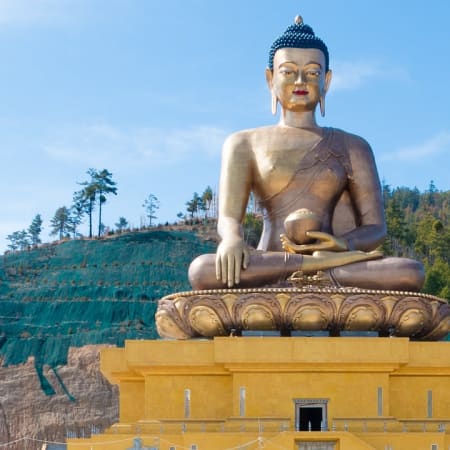
After breakfast, visit Buddha Point (Kuensel Phodrang). It holds one of the largest Buddha statues in the country, standing 169 feet (51.5 m) high, made of bronze and gilded in gold. Visitors can also get a good overview of the Thimphu valley from this point. Then drive to upper Motithang in Thimphu to visit the Takin Preserve. The takin is the national animal of Bhutan and looks like a cross between a cow and a goat. Legend has it that the animal was created by the great Buddhist yogi Drukpa Kuenley, and it can be found only in Bhutan and nearby areas. Taxonomists place the animal in a category of its own, as it is not similar enough to any other animal to fit established categories. Post lunch, enjoy sightseeing in Thimphu valley, including visits to the National Library, which houses an extensive collection of priceless Buddhist manuscripts; the Institute for Zorig Chusum (commonly known as the Painting School), where students undergo a 6-year training course in Bhutan's 13 traditional arts and crafts; the Textile Museum, which provides deep insight into one of Bhutan's most distinct art forms; and the Folk Heritage Museum, dedicated to connecting people with rich Bhutanese folk heritage and rural history through exhibits, demonstrations, educational programs, and documentation of Bhutanese rural life. Then drive up to Dochu-La Pass (3,088 m / 10,130 ft), stopping briefly here to take in the view and admire the chorten, mani wall, and prayer flags that decorate the highest point on the road. If skies are clear, the following peaks can be seen from this pass (left to right): Masagang (7,158 m), Tsendagang (6,960 m), Terigang (7,060 m), Jejegangphugang (7,158 m), Kangphugang (7,170 m), Zongphugang (7,060 m), a table mountain that dominates the isolated region of Lunana, and finally Gangkar Puensum, the highest peak in Bhutan at 7,497 m. Punakha was the former capital of Bhutan and seat of the Government until 1955, when the capital was moved to Thimphu. Wangdue, located towards the south of Punakha, is not more than an enlarged village with a few well-provided shops. On arrival, check in to the hotel. In the afternoon, visit Punakha Dzong, or the 'Palace of Great Happiness or Bliss', built at the junction of the Phochu and Mochu rivers in 1637 by Shabdrung Ngawang Namgyal. This majestic dzong served as both the religious and administrative centre of Bhutan in the past. It measures some 600 by 240 feet and has a six-story, gold-domed tower. Inside are courtyards and religious statuary that hint at the depth of history and spiritual tradition embodied here. Also visit the popular suspension bridge, which makes an excellent spot for a beautiful photo session. Overnight at the hotel in Punakha and Wangdue. (Altitude 1,300m)
-
3Day 03
Drive from Punakha and Wangdue to Paro
After breakfast, drive back to Paro, descending from Dochu La and following the way back up the dramatic Wang Chhu and Paro Chhu river valleys before crossing through Paro town towards the north end of the valley. En route, visit Simtokha Dzong, the oldest fortress in the country, constructed by Zhabdrung Ngawang Namgyel in 1629. The name Simtokha literally means 'Atop a Demon', and the legend associated with the dzong's construction tells us that it was built in order to subdue an evil spirit that was harassing travellers in the region. Later in the day, after checking in to the hotel, proceed to visit Ta Dzong, originally built as a watchtower and now housing the National Museum. The extensive collection includes antique thangkha paintings, textiles, weapons and armour, household objects, and a rich assortment of natural and historic artifacts. Then walk down the trail to visit Rinpung Dzong, meaning 'fortress of the heap of jewels', which has a long and fascinating history. Along the wooden galleries lining the inner courtyard are fine wall paintings illustrating Buddhist lore, such as the four friends, the old man of long life, the wheel of life, scenes from the life of Milarepa, Mount Sumeru, and other cosmic mandala. In the evening, take a stroll around the interesting city centre of Paro. Overnight at the hotel in Paro. (Altitude 2,280m)
-
4Day 04
Paro Excursion to Tiger's Nest or Chelela Pass
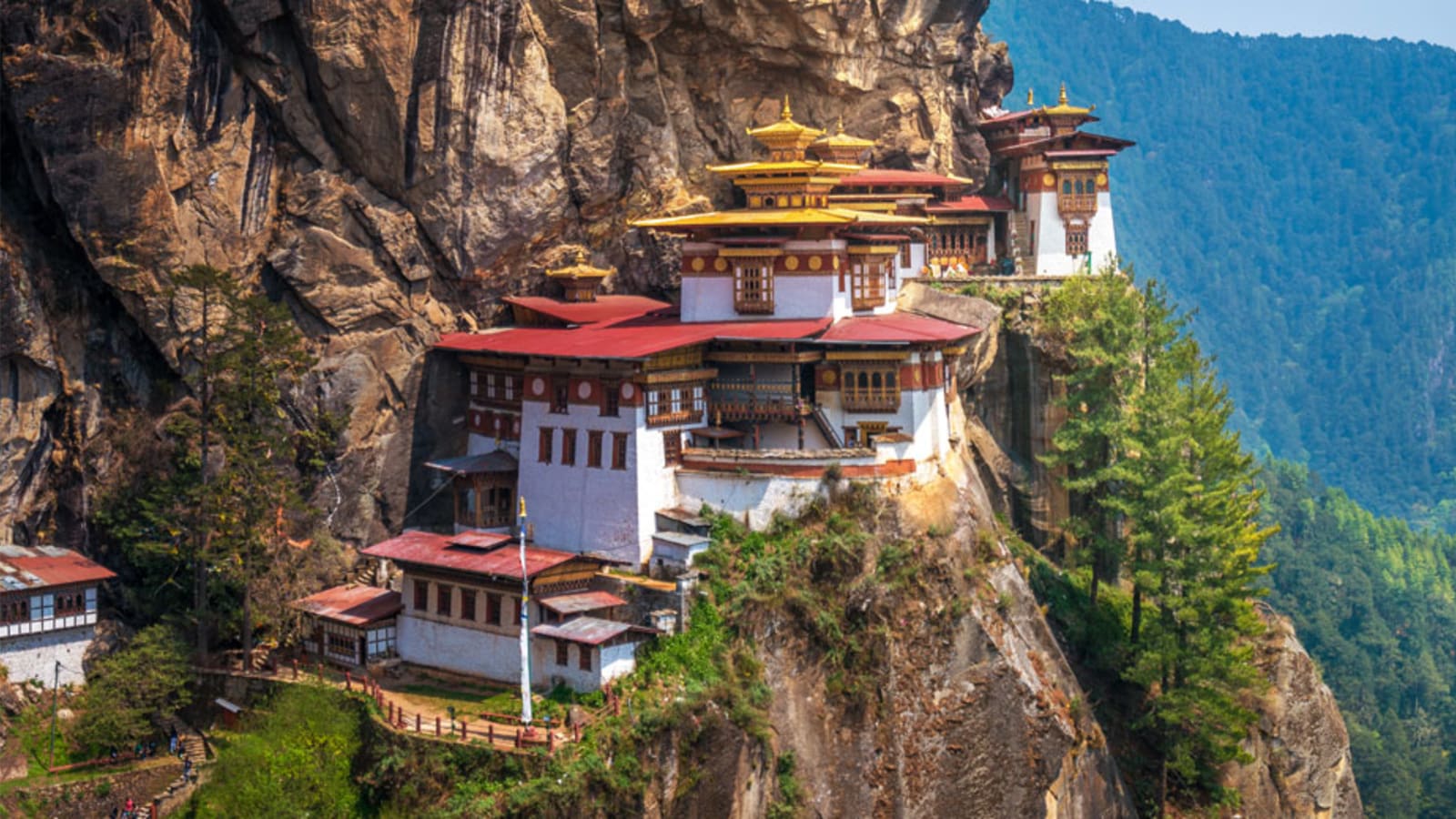
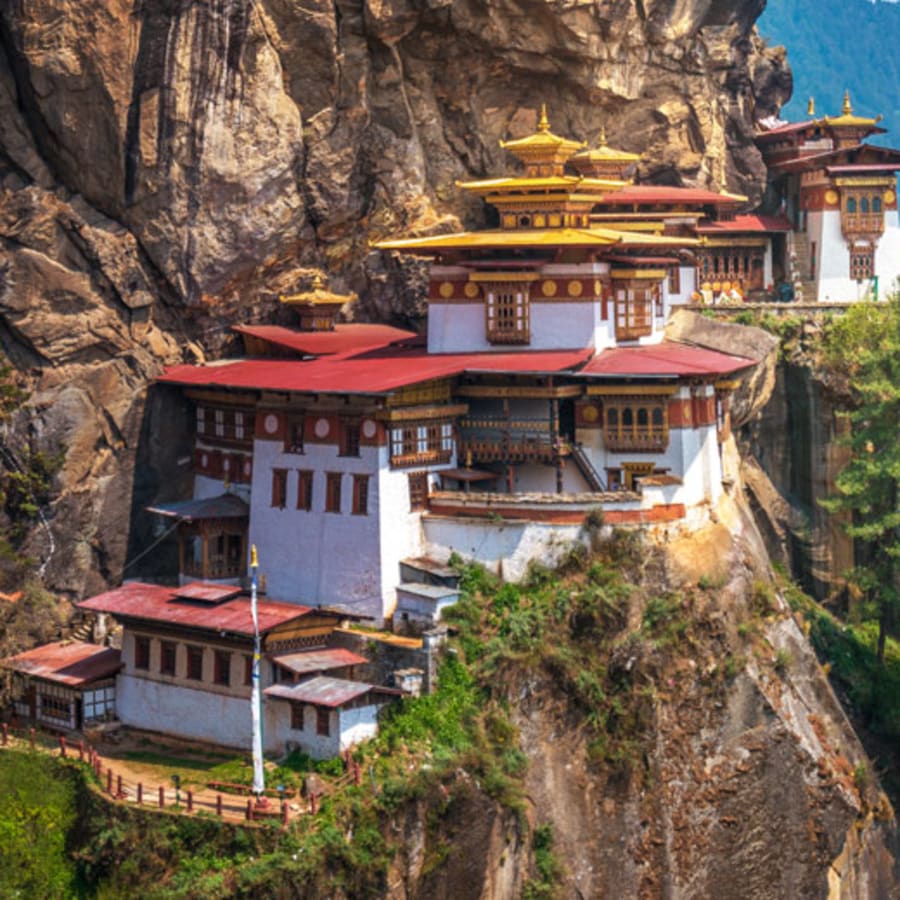
After breakfast, enjoy an excursion to Taktshang Monastery (approx. 5 hours round-trip walk). It is one of the most famous monasteries in Bhutan, perched on the side of a cliff 900 m above the Paro valley floor. It is said that Guru Rinpoche arrived here on the back of a tigress and meditated at this monastery, and hence it is called 'Tiger's Nest'. This site has been recognised as a most sacred place and was visited by Zhabdrung Ngawang Namgyal in 1646. Today, it is visited by all Bhutanese at least once in their lifetime. The hike to the monastery makes a splendid half-day excursion. OR Optional will be as below After breakfast, embark on a driving excursion to Chelela Pass. At an elevation of 3,988 meters, it is considered to be one of the highest motorable passes in Bhutan. About an hour's drive along a thickly forested road, this pass is a botanical paradise. The pass provides stunning views of the sacred mountains Jumolhari and Jichu Drake. It is also marked by hundreds of prayer flags fluttering in the wind. En route, also visit Dzongdrakha temple. Often called mini Taktsang, Dzongdrakha is a cliffside temple complex on the western side of Paro valley. Four shrines make up the complex, dedicated to Drolma (Tara), Tsheringma (Goddess of Longevity), Guru Rinpoche, and the Buddha of the Future, Maitreya. Local oral tradition states that when Guru Rinpoche first came to Bhutan, he came from Nepal, first landing at Drakarpo, then Dzongdrakha, before arriving at Taktsang (Tiger's Nest) farther north up the valley. Later in the afternoon, drive to Drukgyel Dzong, a ruined fortress where Bhutanese warriors fought Tibetan invaders centuries ago. In early 1954, Drukgyel Dzong was completely destroyed by fire, and today only the ruins remain. The snowy dome of sacred Chomolhari, 'mountain of goddess', can be seen in all her glory from the approach road to the dzong. While returning to the hotel, along the way visit the 7th-century Kyichu Lhakhang, one of the 108 temples built in the Himalayas by Tibetan King Songtsen Gampo. The building of this temple marks the introduction of Buddhism in Bhutan. Overnight at the hotel in Paro. (Altitude 2,280m)
-
5Day 05
Departure from Paro
After an early breakfast at the hotel, drive to the airport for your flight to the onward destination. Our representative will help you with exit formalities and then bid you farewell. TASHI DELEK! NOTE:- The given itinerary is customizable as per the travellers' interest.
Meeting Point
Meeting point: Paro, Bhutan · Tour start: Paro, Bhutan — Tour ends at the same location as the start point.