From West to East 5 Balkan countries


About This Tour
Discover the Balkans on a 14-day private journey from Albania to Romania, travelling through five countries rich in history, culture, and UNESCO-listed heritage...
Duration: 14 Days · Tour type: Private · Activity level: Easy · Accommodation: Included · Transport: Included · Wheelchair access: Not applicable · Cities: Berat, Brasov, Bucharest, Durres, Ohrid, Plovdiv, Pogradec, Skopje, Sofia, Kazanlyk, Tirana, Veliko Tarnovo, Pristina, Prizren, Rila Monastery, Matka Canyon, Sinaia · Languages: English
Know before you go: Children must be accompanied by at list 1 adult
About Bucharest

Bucharest
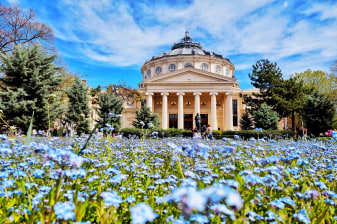
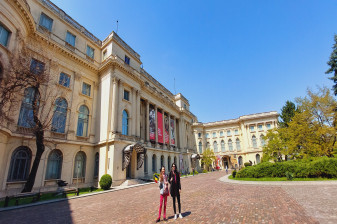
Forged by Wallachian princes and Ceau’escu’s communism, Bucharest pulses with energy. Get a local guide to show you its majestic parks, brutalist architecture and endless museum collections.
What's Included
- Pick up from Tirana airport;
- Private transportation with air conditioned comfortable vehicles suited to your group size;
- Drop-off at Bucharest airport;
- 13 nights accommodation, including hotel taxes and service charges;
- Daily buffet breakfast at hotels;
- Services of an English speaking private driver and local host for the whole tour (for parties up to 3 persons guide will be a driver as well)
- Private guided tours at Skopje, Kosovo tour, Kruje, Tirana, Berat, Ohrid, Sofia, Plovdiv, Veliko Tarnovo, Bucharest, including inside visits as described in the itinerary;
- Admission fees where applicable.
- 1 bottle of water per person / per day complementary.
Not Included
- Accommodation in Single room with supplement of € 630 per person (on request, to be required and paid during the booking process - included in the price for solo travelers)
- Dinner x 13 when minimum 3 persons on tour with supplement of € 386 per person (on request, to be required and paid during the booking process)
- Any other meal (lunch or dinner)
- Gratuities for the driver/guide (not obligatory)
- Personal travel insurance
Itinerary
-
1Day 01
Arrival in Tirana
Upon arrival pick up from the airport and transfer to the hotel in Tirana.Accommodation and overnight in Tirana.
-
2Day 02
Albanian landmarks
Full day tour from Tirana to Berat, via Durres. Tirana, the capital of Albania, is known for its colorful Ottoman-, Fascist- and Soviet-era architecture. Pastel buildings surround the city's focal point, Skanderbeg Square, which is named for its equestrian statue of a national hero. On the square's north end is the modernist National History Museum, covering prehistoric times through Communist rule and the anti-Communist uprisings of the 1990s. Durrës is a port city on the Adriatic Sea in western Albania, west of the capital, Tirana. It’s known for its huge Roman amphitheater. Nearby is a 9th-century church with mosaic-covered walls. The Archaeological Museum displays pieces from the Greek, Hellenistic and Roman periods. Broad Durrësi Beach has shallow waters. Nearby is the former summer villa of 20th-century King Zog. Drive towards central part of Albania and the city of Berat.Berat is a city on the Osum River, in central Albania. It's known for its white Ottoman houses. On a hilltop, Berat Castle is a huge compound now inhabited by townspeople. Within its walls are Byzantine churches, the Red Mosque and the Onufri National Museum, with Christian icons. East is the Ethnographic Museum, in an 18th-century house, displaying traditional crafts and part of a reconstructed medieval bazaar. Accommodation and overnight in Berat.
-
3Day 03
Welcome to Macedonia
Drive from Berat towards Macedonian border, driving along Ohrid lake coast and the city of Pogradec.Border crossing and arrival at St. Naum monastery. Monastery which is founded by St. Naum at 9thCentury is visited by pilgrims and travelers alike. It is one of the few with locational and architectural splendor and without any doubt, one of the most attractive Macedonian tourist destinations.Overlooking Ohrid lake, the walls provide breathtaking panoramic views of the entire bay area. Near the monastery, you can enjoy a boat ride above the springs of the river Black Drim which flows into Ohrid lake In the afternoon drive along the lake and towards the city of Ohrid, UNESCO site. Accommodation and overnight in Ohrid.
-
4Day 04
Ohrid and Ohrid lake
Full day in Ohrid with walking tour in the old town. Because of the religious importance and its numerous churches and monasteries, Ohrid is also famous under the name “Macedonian Jerusalem”. According the history facts, there used to be 365 churches – a church for each day! In 12th century, the city was also the seat of Archbishop of Ohrid. Since 1979 the city and the lake of Ohrid are under protection of UNESCO. According to recent excavations by Macedonian archaeologists, Ohrid fortress of Tsar Samoil was contended that this fortress was built on the place of an earlier fortification, dated to the 4th century BC, which was probably built by King Philip II. Saint John the Theologian, Kaneo or simply Saint John at Kaneo is a Macedonian Orthodox church situated on the cliff over Kaneo Beach overlooking Lake Ohrid. The church is dedicated to John of Patmos, the writer of Revelation, who has been by some considered to be the same person as John the Apostole. The construction date of the church remains unknown but documents detailing the church property suggest that it was built before the year 1447. St Sofia church is one of the most important Byzantine churches in Macedonia and the biggest church in Ohrid. The current church was built on the foundations of a metropolitan cathedral demolished in the first decade of the 6th century. It was basically rebuilt in the last decade of the 10th century as a patriarchal cathedral in the form of a dome basilica. Free afternoon in Ohrid old town. Overnight in Ohrid.
-
5Day 05
West part of Macedonia
Drive from Ohrid on the picturesque road along Black Drim river and lakes made by this river. The National Park Mavrovo is located in western Macedonia and occupies an area of 73,088 hectares. And it is the largest among the three national parks in Macedonia, Pelister and Galicica. As a national park Mavrovo it was declared in 1949 and its geographical position is 41° 40'N and 20° 46'E. Within the limits of the park are the mountains: Korab, Desat, southwestern branches of Shar mountain, most of Bistra and the northern parts of Krchin. The central part of the national park Mavrovo covers the valley and the river basin of Radika.The Mavrovo artificial lake is also within the national park. The Bigorski monastery St. John the Baptist is located in the immediate vicinity are the villages of Rostushe, Bituse, Velebrdo and Trebiste, along the river Radika, in western Macedonia. According to the Bigorski monument, the monastery was founded by the monk Jovan in 1020, and in the 16th century the monastery was destroyed by the Ottoman authorities and only one small church remained from the whole complex. In the afternoon arrival in Matka lake and canyon. It is the valley of the butterflies and very characteristic locality in the immediate vicinity of Skopje, at the exit of the river Treska from the long Sishevska Ravine. Matka is a complex of deep, incised canyon, in which the first artificial accumulation on the Balkan Peninsula was built in 1938. There are several caves, an alpine training centre, a regulated flow of Treska for rafting, a complex of several monasteries, a mountain lodge, restaurants, catering facilities, a picturesque nature with rich vegetation and animal life. Overnight in Skopje.
-
6Day 06
Day tour to Kosovo
Full day tour to Kosovo, the youngest European country. Officially the Republic of Kosovo, is a partially-recognized state in Southeastern Europe. On 17 February 2008, Kosovo unilaterally declared its independence from Serbia. It has since gained diplomatic recognition as a sovereign state around 100 UN member states. Geographically defined in an area of 10,887 km2, Kosovo is landlocked in the center of the Balkans and bordered by the uncontested territory of Serbia to the north and east, Macedonia to the southeast, Albania to the southwest and Montenegro to the west. Grachanica monastery is unique Serbian Orthodox monastery located in the small village of Gracanica. It was built by the Serbian king Stefan Milutin in 1321 on the ruins of a 6th-century basilica. The monastery was declared a Monument of Culture of Exceptional Importance in 1990, and on 13 July 2006 it was placed on the UNESCO World Heritage List under the name of Medieval Monuments in Kosovo. As the Kosovo capital and the biggest city, Pristina is the seat of the eponymous municipality and district. You will have a chance to walk in the main pedestrian zone and feel the vibrant life of this city. Picturesque town of Prizren is located on the south-eastern part of the country and it is designated as the historical capital of Kosovo. A lot of Christian and Muslim monuments make this town unique. Prizren is one of the oldest settlements in Kosovo and the western Balkans. Prizren has been traditionally identified with the settlement of Theranda in Roman Dardania. The Sinan Pasha Mosque is an Ottoman mosque and one of remarks of Prizren. It was built in 1615 by Sofi Sinan Pasha, bey of Budim. The mosque overlooks the main street of Prizren and is a dominant feature in the town's skyline. Drive back to Skopje for overnight.
-
7Day 07
Skopje city tour and Tikvesh wine region
Skopje is a city in the central part of the Balkan Peninsula. It communicates easily with the Mediterranean region to the south and the area of Central and Northern Europe to the north. It is located 240 m above sea level and occupies 1.818 km2, surrounded by mountain massifs, gorge valleys, many rivers, city with long history and traditional values, many legends about its increasing. Skopje is the birthplace of the famous humanist and Nobel prize winner Mother Teresa.The Stone Bridge is a bridge across the Vardar River in Skopje, the capital of the Republic of Macedonia. The Stone Bridge is built of solid stone blocks and is supported by firm columns that are connected with 12 semicircular arcs. The bridge is 214 m long and 6 m wide. The current Stone Bridge was built on Roman foundations under the patronage of Sultan Mehmed II, the Conqueror between 1451 and 1469. In the afternoon drive towards central part of Macedonia and the wine region of Tikvesh. Because of smooth climate and plenty of sunny days, grapes and wine producing is traditional occupation for the locals ever since ancient times. High quality grape types such as Sauvignon, Vranec, and Merlot are just a part of the unique taste of Macedonian wines. Another famous Macedonian brand named “Rakija” (a fiery brandy) is produced in this region. Overnight at the boutique hotel located at local winery, with dinner and wine tasting. Meals: Breakfast at the hotel, Dinner and wine tasting at the winery restaurant
-
8Day 08
Welcome to Bulgaria
Morning drive towards Bulgaria and afternoon visit to Rila Monastery, UNESCO site. The Monastery was founded in the 10th century by St John of Rila, a hermit canonized by the Orthodox Church. His ascetic dwelling and tomb became a holy site and were transformed into a monastic complex which played an important role in the spiritual and social life of medieval ages. Destroyed by fire at the beginning of the 19th century, the complex was rebuilt between 1834 and 1862. The monument symbolizes the awareness of a Slavic cultural identity following centuries of occupation. Upon arrival in Sofia, accommodation and overnight.
-
9Day 09
Sofia, the Bulgarian capital
Morning city tour by walking in Sofia. Sofia is the capital of Bulgaria, situated in the west of the country, below Vitosha Mountain. The city’s landmarks reflect more than 2,000 years of history, including Greek, Roman and Ottoman occupation. Medieval Boyana Church has 13th-century frescoes. Built by the Romans in the 4th century, St. George Rotunda Church has medieval and Ottoman decoration dating to the 10th century. Afternoon at leisure and possibility to visit nearby Boyana church. Overnight in Sofia, 4* hotel Meals: Breakfast at the hotel
-
10Day 10
Plovdiv and Bachkovo monastery
Morning drive towards Plovdiv. Plovdiv is the second-largest city in Bulgaria and the most populous city in the Bulgarian part of the historic region of Thrace, built around 7 hills. The Regional Archaeological Museum chronicles the city’s history, with exhibits including mosaic panels, clay lamps and early coins. The Roman-era Ancient Theatre of Philippopolis, which once seated around 6,000, now hosts opera and concerts. A 3D movie at the Emperor Hadrian–era Ancient Stadium re-creates Plovdiv in the 2nd century A.D. Afternoon visit to Bachkovo monastery, UNESCO heritage The Bachkovo Monastery of the Dormition of the Theotokos, archaically the Petritsoni Monastery or Monastery of the Mother of God Petritzonitissa is a major Orthodox monastery in Southern Bulgaria and the second largest monastery in Bulgaria. It is beautifully situated on a ledge, on the right from the Valley of Chepelarska River. Overnight in Plovdiv.
-
11Day 11
Central part of Bulgaria
Morning drive towards central part of Bulgaria with stop at Etar, Architectural-Ethnographic Complex is an open-air museum. It is on the northern edge of the Bulgarka Nature Park, between the park and the city of Gabrovo. It presents Bulgarian customs, culture and craftsmanship. Later on arrival and visit to the Thracian Tomb of Kazanlak, another UNESCO site on this tour. Discovered in 1944, this tomb dates from the Hellenistic period, around the end of the 4th century BC. It is located near Seutopolis, the capital city of the Thracian king Seutes III, and is part of a large Thracian necropolis. The tholos has a narrow corridor and a round burial chamber, both decorated with murals representing Thracian burial rituals and culture. Afternoon arrival in Veliko Tarnovo - the literal translation of its name is "Great Tarnovo" and it is the historical and spiritual capital of Bulgaria. Often referred to as the "City of the Tsars, Veliko Tarnovo is located on the banks of Yantra river and is famously known as the historical capital of the Second Bulgarian Empire, attracting many tourists with its unique architecture. The old part of the town is situated on three hills, rising amidst the meanders of the Yantra. On Tsarevets hill are the palaces of the Bulgarian emperors and the Patriarchate and also a number of administrative and residential edifices surrounded by thick walls. Overnight in Veliko Tarnovo.
-
12Day 12
Welcome to Romania
Drive towards Romania and its capital Bucharest. Upon arrival a city tour with local guide will be provided. Bucharest, in southern Romania, is the country's capital and commercial center. Its iconic landmark is the massive, communist-era Palatul Parlamentului government building, which has 1,100 rooms. Nearby, the historic Lipscani district is home to an energetic nightlife scene as well as tiny Eastern Orthodox Stavropoleos Church and 15th-century Curtea Veche Palace, where Prince Vlad III (“The Impaler”) once ruled. Known for its wide, tree-lined boulevards, glorious Belle Époque buildings and a reputation for the high life (which in the early 1900s earned its nickname of "Little Paris"), Bucharest today is a bustling metropolis. Legend has it that the city of Bucharest was founded by a shepherd named Bucur, whose name literarily means "joy." His flute playing reportedly dazzled the people and his hearty wine from nearby vineyards endeared him to the local traders, who gave his name to the place. Afternoon at leisure in overnight in Bucharest.
-
13Day 13
Day trip to Transylvania region
Full day trip to one of the most famous sights of Romania. Sinaia is a town in central Romania’s Bucegi Mountains, surrounded by ski trails. Its 17th-century Sinaia Monastery was once a royal family residence. German neo-Renaissance Peleș Castle, now a museum, has Klimt frescoes and stained-glass windows. The smaller, neighboring Pelișor Castle has a half-timbered facade. Across the Prahova River, the George Enescu Memorial House is the former home of the Romanian musician. Brasov is a city in the Transylvania region of Romania, ringed by the Carpathian Mountains. It's known for its medieval Saxon walls and bastions, the towering Gothic-style Black Church and lively cafes. Piaţa Sfatului (Council Square) in the cobbled old town is surrounded by colorful baroque buildings and is home to the Casa Sfatului, a former town hall turned local history museum. Bran Castle is a castle in Bran, 25 kilometres southwest of Brașov. The castle was built by Saxons in 1377 who were given the privilege by Louis I of Hungary. It is a national monument and landmark in Transylvania. The fortress is on the Transylvanian side of the historical border with Wallachia. Drive back to Bucharest for overnight.
-
14Day 14
Departure
Depending on the flight schedule, transfer to Bucharest airport. End of the program.
Meeting Point
Meeting point: Tirana, AL · Tour start: Tirana, AL — Tour ends at the same location as the start point.